All the Chess Pieces, Explained: Counts, Moves, Values and Sizes for 2026
Every piece on the board, its count, its move, its value, and the sizes that actually suit a beginner.
Chess has 32 pieces in total, 16 for each player, and every one of them is a king, queen, rook, bishop, knight, or pawn. Six types, that's the whole roster. The part that snags beginners isn't the count, it's the movement: bishops that only travel diagonally, knights that hop in an L, pawns that capture in a different direction than they walk. I've taught this at club nights for years, and the tangle usually clears in two or three games, not two or three diagrams. Here's every piece, what it does, what it's worth, and how big it should be in your hand.
The six types, how many of each, and the value numbers
| Piece | How many per side | Value in pawns | One-line job |
|---|---|---|---|
| King | 1 | not scored | Survives, or the game ends |
| Queen | 1 | 9 | Attacks in every direction, any distance |
| Rook | 2 | 5 | Owns open files and ranks |
| Bishop | 2 | 3 | Cuts along diagonals |
| Knight | 2 | 3 | Jumps in an L and can't be blocked |
| Pawn | 8 | 1 | Walks forward, captures sideways |
Add it up and you get 1 + 1 + 2 + 2 + 2 + 8, which is 16 per side. Thirty-two on the board, and 34 in some tournament sets because two spare queens get included for promotions; the WE Games set further down ships exactly that way. If you want the counts alongside the promotion rules, my page on how many pieces in chess lays it out.
Values give you a way to compare pieces you can't compare by eye. A pawn is 1, a knight or bishop is 3, a rook is 5, the queen is 9, and the king doesn't get a number because losing him ends the game. Trading a rook for a bishop is a bad deal by that arithmetic, and club players do it every week anyway, usually because the bishop looked busy at the time. The chess piece values page has the full chart and the swaps that quietly lose games.
What each piece actually does
King: one square, eight directions, whole game riding on him
He steps one square in any direction, so a king in the middle of the board covers 8 squares and a king stuck in the corner covers 3. He can't step into check and he can't stand next to the other king. New players always ask whether he can capture; he can, as long as the square he lands on isn't attacked, and the guide to the king in chess walks through the cases where that goes wrong.
Queen: 27 squares from the middle, and too much for most beginners
Any distance along a rank, a file, or a diagonal. On an empty board in the center she reaches 27 squares, which is why she's worth 9 pawns. She's also the piece beginners overuse: out she comes on move two to grab a loose pawn, then a knight and a bishop chase her around the board for ten moves. Develop the small pieces first.
Rook: straight lines, 14 squares, useless until the files open
Rooks move along ranks and files only, no diagonals, up to 14 squares from the middle of an empty board. They start in the corners and do nothing until pawns get out of the way, which is why the old advice is to get them onto open files by move 12 or so. Castling is the fast route: king two squares toward the rook, rook hops to the square the king crossed.
Bishop: diagonals only, stuck on one color for life
Each bishop lives on one color forever, so you always have a light-square bishop and a dark-square bishop. From a central square one bishop reaches 13 squares; from a corner it manages 7. The pair together covers the whole board, which is why two bishops usually beat two knights in an open position. If your bishop is doing nothing, look at your own pawns first, because they're probly sitting on its color. More on the bishop chess piece and its bad-square habits.
Knight: the only jumper, 8 squares from the center, 2 from a corner
Two squares one way, then one square at a right angle. Nothing blocks a knight, which is why it's the piece that survives a locked pawn structure. From the center it reaches 8 squares, from a corner just 2. The old rhyme is that a knight on the rim is dim, and it's still the fastest way to explain why the knights on f3 and c3 feel twice as strong as the ones on a1 and h1.
Pawn: forward to move, diagonal to capture
One square forward, two from its starting rank, and captures one square diagonally forward. That mismatch is where beginners lose material in the first ten moves. En passant exists, promotion exists, and a pawn reaching the eighth rank becomes a queen in almost every case. Eight of them at 1 point each, and pawn structure is the part of chess that took me longest to understand.
How the 32 pieces line up before the first move
| Rank | What sits there |
|---|---|
| 1 (White) | Rook, knight, bishop, queen, king, bishop, knight, rook |
| 2 (White) | Eight pawns |
| 3 to 6 | Empty at the start |
| 7 (Black) | Eight pawns |
| 8 (Black) | Black back rank, mirrored |
White fills ranks 1 and 2, black fills 7 and 8. Queen on her own color: white queen on d1, a light square, black queen on d8, a dark one. Knights beside the rooks, bishops beside the knights, king on the one square left over. Coordinates are worth learning early because club players talk in them, and "knight to f3" gets you further than "the horse thing"; the piece names and where they came from are covered under chess pieces meaning if that interests you.
Sizes and weights worth checking on a listing
US Chess guidance puts king height between 3.375 and 4.5 inches, squares between 2 and 2.25 inches, and the king's base at about 75 to 80 percent of a square. Get that ratio wrong and the board looks crowded; a 4.5 inch king on 1.5 inch squares is a decoration, not a playing set. Weight matters too, and here's the gap: none of the three listings below gives a piece weight, so I can't compare them on heft. What I can compare is the shape. A 3.75 inch king on 2.25 inch squares is the tournament standard, and it's the size I'd point any adult or kid over 8 toward.
If you need a set to learn on
I haven't unboxed any of these three, so I'm going on the listings and the specs rather than my own hands. Prices move around too much week to week for me to quote them honestly.

Spin Master Games Cardinal Classics Chess Teacher
- Includes: Chessboard, 32 Chess Pieces, Instructions
The listing says each piece carries its name and shows which direction and how many squares it moves, which is exactly the training wheels a brand new player needs for the first week, and the box includes the board, 32 pieces and instructions.

A folding cardboard board and standard flat-bottomed plastic pieces, aimed at ages 6 and up, and the cheapest sensible way to find out whether a kid actually likes chess before you spend real money.
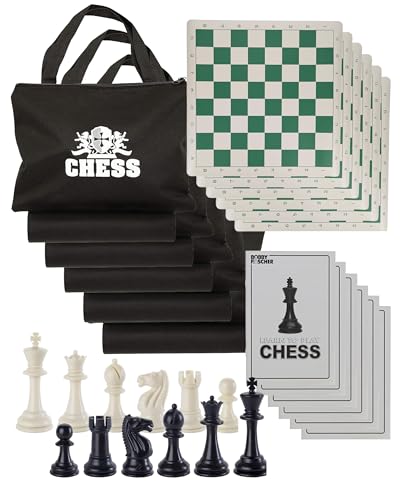
34 pieces including two extra queens, a 3.75 inch king, a 19.75 inch roll-up vinyl board with 2.25 inch squares, a bag and equalizer dice, and the listing says it meets FIDE and USCF height and weight proportions.
My one reservation about the Chess Teacher set: those printed arrows and move counts look busy, and anyone past the beginner stage will find the labels distracting during a real game. That's fine. It isn't built for them.
Practical next step: set up all 32 pieces tonight and play one game where you say every move out loud, piece name and square, at 10 minutes a side. It feels silly for about four moves, then it fixes your board vision faster than any video. If you're starting from zero, work through learn chess first and come back to the board with the basics in hand.
Questions people ask me
How many chess pieces are there in total?
Thirty-two, which is 16 per side across six types. Each player starts with one king, one queen, two rooks, two bishops, two knights and eight pawns.
Which chess piece is the strongest?
The queen, at roughly 9 pawns of value, because she moves any distance along a rank, file or diagonal. The king matters more than any piece but he isn't strong; he covers one square at a time and the game ends when he can't escape check.
What size chess set should a beginner buy?
US Chess guidance puts king height at 3.375 to 4.5 inches, squares at 2 to 2.25 inches, and the king's base at 75 to 80 percent of a square. A 3.75 inch king on a 2.25 inch square board is the tournament shape and stays comfortable for adults and kids over about 8.