A Chess Board Without Pieces: Print It, Scale It, Play on It
A printed board is a grid and a promise. Scale the squares to your pieces and you can play tonight.
Free downloads
PDFs, 0.9 inch squares. Print at 100% (actual size), not “fit to page”.
- Blank board with coordinates: US Letter · A4
- Blank board, no coordinates: US Letter · A4
- Board with pieces in the starting position: US Letter · A4
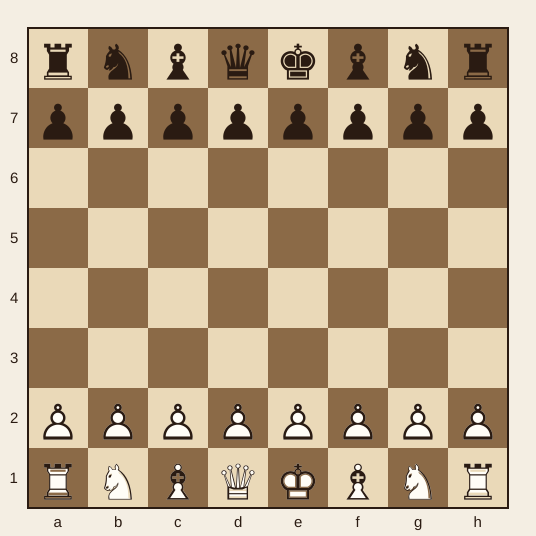
A chess board without pieces is a grid, nothing more. 64 squares, eight by eight, lines dark enough to read from across a table. You print it, you scale it so the squares fit the pieces you already own, and you play. The free printable files are linked on this page and are set up for both US Letter and A4.
I've watched people burn forty minutes hunting for a spare board at a club night when a sheet of paper and a roll of tape would've solved it in five.
What gets printed, sheet by sheet
The set comes in two versions. One is a full board on a single page, which gives you squares just under 1 inch. That's fine for puzzle diagrams and notation drills, and too small for real play with a 3.75 inch king. The other is a tiled version you print across four sheets for a board with 2 to 2.25 inch squares.
Do the math before you hit print. Eight squares at 2.25 inches is 18 inches of playing surface. A Letter sheet is 8.5 by 11. One page can't hold a tournament-sized board, not even close. Four pages, each carrying a 4x4 block of squares, need 9 inches of paper and fit inside 11 with room for a border.
If you'd rather skip the tape and cardstock entirely, the chess boards section covers the buying side from cheap roll-ups to solid wood.
Print settings that decide whether the squares come out right
Set the printer to 100% or "actual size." Every print dialog has a "fit to page" or "shrink to fit" default that will quietly resize your board by 6 to 10 percent, and then a 2.25 inch square becomes 2.05. Turn it off. Print one test sheet, put a ruler on a single square, and measure it. If it's off, change the scale percentage in the dialog and run it again instead of trimming later.
Cardstock at 65 to 110 lb feeds through most home printers and takes tape better than copy paper. It also resists the corner curl that hits a thin sheet after a week on a table.
For the regulation look, squares between 2 and 2.5 inches and a king between 3.375 and 4.5 inches tall, which is the same band US Chess uses for equipment guidance, the four-sheet version gets you there. To feel what a proper surface is like next to paper, the guide to the best chess boards for tournament play walks through roll-up mats and wooden boards.
Trimming, taping, and laminating
Trim the white margin off the inner edges before you tape, and leave it on the outer edges. Butt the sheets edge to edge on a flat surface, tape across the seam on the back with two strips, then check that the squares on either side of the seam match in width. That seam is where every printed board fails. A hairline overlap of a millimeter shows up the moment a knight lands on it.
Laminate if the board will see classrooms or kids. A 5 mil pouch survives dry erase markers and one dropped juice box. A 3 mil pouch is cheaper and fine for occasional use. Pieces slide on a bare laminated surface, though, so plan on a sheet of felt or a cork mat underneath.
Matching square size to the pieces you own
This is the part people skip. Measure the base of your king, not its height. US Chess guidance puts the king base at roughly 75 to 80 percent of the square, so a 1.5 inch base wants a 2 inch square and a 1.75 inch base wants 2.25. Go smaller and the board looks crowded, pieces clip each other, and a knight's hoof hangs over the line.
| King base (inches) | Smallest sensible square | Notes |
|---|---|---|
| 1.25 | 1.5 | Small travel sets, tight but playable |
| 1.5 | 2 | Most club sets |
| 1.75 | 2.25 | Standard tournament territory |
| 2.0 | 2.5 | Oversized pieces, big tables |
If the printout is a stopgap for a kid learning the moves, a 1 inch square board on one page is honestley fine. Small hands, small pieces, and the whole thing sits flat in front of them. The best chess boards for kids page covers what to graduate to once they stop knocking pieces off the table.
Counting the pieces you'll need
A board without pieces is half a set. Before you print, check you've got 32 pieces: 16 a side, 8 pawns, 2 rooks, 2 knights, 2 bishops, a queen, a king. Mismatched bags are normal. Two white queens and no black knight happens more often than you'd guess, and a printed board makes a decent surface for sorting a junk box.
| Print sheet | Files | Ranks | Squares per sheet |
|---|---|---|---|
| 1 (top left) | a to d | 5 to 8 | 16 |
| 2 (top right) | e to h | 5 to 8 | 16 |
| 3 (bottom left) | a to d | 1 to 4 | 16 |
| 4 (bottom right) | e to h | 1 to 4 | 16 |
Light square in the bottom right corner. Always. If your taped board has a dark square there, one of the four sheets went down in the wrong spot.
Using a paper board for teaching and analysis
Teachers get the most out of these. Print one board per pair of students, laminate, hand out dry erase markers, and have them circle the square they want before they touch a piece. A 21 inch board shared by two kids beats a projected diagram every time, and you can reprint a ruined one for pocket change.
For group demos where everyone needs to see from across the room, a mounted board is the better tool, and the best wall chess boards guide covers hanging options. Paper still works for small groups, and it costs nothing to replace when someone folds it in half.
I'll be blunt about the tradeoff. A laminated printout will not feel like wood, it will shift on a smooth table, and after a year of club nights the corners go soft. That's fine. It's a placeholder that costs about 40 cents and lets you play tonight.
When you're ready for a real board
Both options below are sold as board only, no pieces included.

Peradix Wooden Chess Board Large 21.25" Professional Tournament Chess…

Tournament Chess Mat
- Size: About 34.5cm, 42cm. Suitable for kids and adults, travel, relaxing after class.
The Peradix listing gives 2.2 inch squares on a 21.25 inch board, 0.6 inches thick, in ebony and maple, with a canvas tote and four felt pads on the bottom. That 2.2 inch square sits right in the tournament band. Thickness matters more than people expect, since a heavy board doesn't walk across the table when you slide a rook. If you want your printed dimensions in wood, this is the closest match.
The Frandilo goes the other direction: a PU leather roll-up mat listed at 34.5cm and 42cm overall, board only, with algebraic notation around the edge. The listing doesn't give a square size, so measure your king base before you commit. Still, a roll-up mat is what I'd pack for a club night or a car trip where a wooden board would get banged around, and I'd keep a hard tube for it.
If loose pieces are already taking over a shelf, the guide to the best chess board with storage covers the boxes that solve it properly.
Questions people ask me
What size should the squares be on a printable chess board?
Aim for 2 to 2.25 inches for standard club pieces. US Chess guidance puts tournament squares between 2 and 2.5 inches, with the king base about 75 to 80 percent of the square. Measure the base of your king, not its height, then pick the square that fits it.
How do I stop the printer from shrinking the board?
Set the print dialog to 100% or actual size and turn off fit to page. That setting quietly rescales pages by 6 to 10 percent, which throws the squares off. Print one test sheet, measure a single square with a ruler, and adjust the scale before you print the rest.
Can I use a printed board for teaching if I don't have a full set of pieces?
Yes. Count out 32 pieces first, since a mismatched bag with two white queens still plays fine. Laminate the board, hand out dry erase markers, and have students circle the target square before they move a piece. A 1 inch square board on one sheet is plenty for beginners.