Chess Pieces Movement Diagram: A Printable That Actually Teaches the Moves
A one-page movement diagram you can print at home, scale to your board, and hand to a kid at the kitchen table.
Free downloads
PDFs, 0.9 inch squares. Print at 100% (actual size), not “fit to page”.
- Blank board with coordinates: US Letter · A4
- Blank board, no coordinates: US Letter · A4
- Board with pieces in the starting position: US Letter · A4
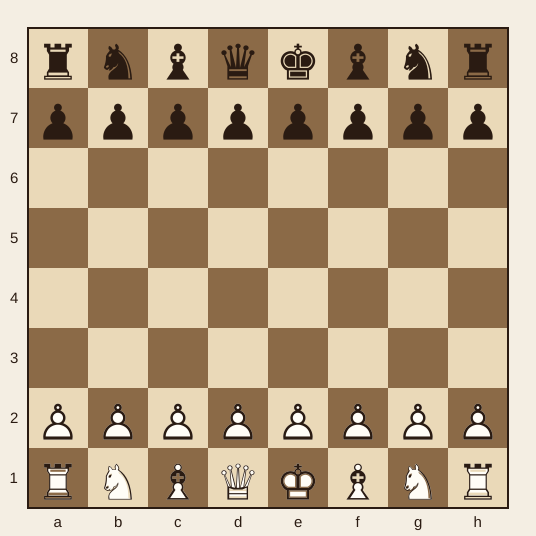
Here's the short answer. A chess pieces movement diagram is one page showing all six piece types, the squares each one can reach from a marked spot, and the three rules beginners always miss: pawn captures, castling, and en passant. Print it at 100 percent on US Letter or A4, check one printed square with a ruler, and laminate it if a kid will be holding it. The free printable files are linked on this page.
That's the answer. The rest of this page is about getting the scale right (2 to 2.25 inch squares is the number that matters) and using the sheet at a real board instead of letting it become another piece of paper in a drawer.
The six pieces and how far each one travels
The diagram's real job is distance. A queen sitting in the open touches 27 squares; a knight touches 8 no matter where you park it. That gap is the entire lesson, and it's why a chart beats a paragraph of rules text every time.
| Piece | How it moves | Most squares from one spot | Jumps over pieces? |
|---|---|---|---|
| Pawn | 1 forward, 2 on its first move, captures diagonally | 2 (first move only) | No |
| Knight | L shape: 2 squares one way, 1 the other | 8 | Yes |
| Bishop | Diagonals, any distance | 13 | No |
| Rook | Ranks and files, any distance | 14 | No |
| Queen | Rook moves plus bishop moves | 27 | No |
| King | 1 square in any direction | 8 | No |
Count them out loud with a beginner. The bishop number surprises people, because a bishop stuck in the corner only sees 7 squares while a bishop on an open long diagonal sees 13. Same piece, half the reach. The chess pieces library on this site goes piece by piece if you want the full rundown, and the bishop's color-bound habit is covered in detail in the bishop chess guide.
The exact squares each piece reaches from a marked square
Most printable diagrams draw arrows. Arrows are fine, but coordinates stick in the memory longer, and a parent who can say "b5" out loud is already teaching notation by accident.
| Piece and square | Squares it reaches |
|---|---|
| Rook on a1 | a2 through a8, b1 through h1 (14 squares) |
| Knight on d4 | b3, b5, c2, c6, e2, e6, f3, f5 (8 squares) |
| Bishop on c1 | b2, a3, d2, e3, f4, g5, h6 (7 squares, all light) |
| Queen on d1 | the full d-file, the full first rank, both diagonals (21 squares) |
| King on e1 | d1, d2, e2, f2, f1 (5 squares before castling) |
| Pawn on e2 | e3 and e4 |
A knight on the rim reaches 2 squares only, down from 8 in the middle. That single number explains a rule of thumb most adults never hear stated plainly, and it's why I tell kids to keep knights near the center. If your new player has asked whether the queen can turn a corner, the answer is in can queen move in l shape, and it's a shorter read than you'd expect.
Printing: paper size, scaling, and the 2 inch square
Open the print dialog and set scaling to 100 percent or "Actual size." Turn off "Fit to page," which is the setting that quietly shrinks everything by 6 to 10 percent and throws off your measurements. US Letter is 8.5 by 11 inches; A4 is 210 by 297 millimeters. Both work.
Now measure. A full 8x8 grid squeezed onto 8.5 inches gives you squares around 0.9 inches once margins eat their share, which is too small for a standard 3.75 inch king to sit on without looking ridiculous. Tournament boards run 2 to 2.25 inch squares with a king base at roughly 75 to 80 percent of that square. A board at that size needs about 18 inches of playing area plus a border, so call it 20 by 20 inches. Enlarge to 200 percent and tile it across four sheets of Letter, then tape the seams on the back.
If you only want the reference sheet, skip all of that. Print single-sided at 100 percent, trim the margin, and tape it inside the lid of the box. A laminated card lives longer than a loose sheet.
For lamination, a 3 mil pouch is plenty for a kitchen table placemat. Go 5 mil if the sheet is headed into a classroom with 25 kids. A dry erase marker turns the diagram into a worksheet: circle the knight's eight squares, trace a rook's path, cross out the pawn's illegal forward capture.
Using the sheet at the board without turning it into homework
Six pieces, six short sessions, 10 minutes each. That's the whole plan. Rook first, because straight lines are easy to say, then bishop, queen, knight, pawn, king. Put the diagram beside a real board and move actual pieces, not fingers on paper.
And here's my concession: a printed diagram can teach where pieces go, but it can't teach why a move is good. Ten minutes of playing badly beats an hour of studying arrows. The learn chess section is the natural next step once the moves are automatic, and it assumes nothing.
I've watched this at club nights for years. The kids who get a diagram and then play 20 games in a month always pass the kids who memorized the rules from a book and never sat down at a board.
Three rules the arrows never show
Pawn captures trip up every beginner. A pawn on e4 captures a piece on d5 or f5, never on e5, and it can never capture straight ahead. Draw that with a marker on the laminated sheet.
Castling needs its own row: king moves two squares toward the rook, rook hops to the other side of the king, neither piece has moved yet, the king isn't in check, and the squares between are empty. The king in chess page covers the check restrictions in full, including the one about not castling through an attacked square.
En passant is legal for exactly one move, immediately after the opponent's two-square pawn push. Miss the window and the right is gone. Also worth adding by hand: a pawn reaching the eighth rank promotes, and you can pick a queen.
The setup grid, if your printable is blank
Some diagrams ship with arrows and no starting position. Use this to fill in the back ranks. Total on the board: 32 pieces.
| Square | White piece | Black piece |
|---|---|---|
| a1 / a8 | rook | rook |
| b1 / b8 | knight | knight |
| c1 / c8 | bishop | bishop |
| d1 / d8 | queen | queen |
| e1 / e8 | king | king |
| f1 / f8 | bishop | bishop |
| g1 / g8 | knight | knight |
| h1 / h8 | rook | rook |
| a2 to h2 / a7 to h7 | 8 pawns | 8 pawns |
Two checks before the first move: light square on the right (h1 is light), and the queen starts on her own color. Get those wrong and the whole diagram looks off. The how many pieces in chess page has the full count breakdown if a kid asks why there are 16 per side and only 6 types.
When you're ready for a real board
Two sets show up in front of beginners constantly, and they solve diffrent problems.
The Cardinal Classics Chess Teacher prints the movement rules on the pieces themselves, which means the diagram and the board become the same object. The listing says the large pieces show direction and the number of spaces each piece moves, and the box includes the board, 32 pieces, and instructions, for ages 8 and up. I'd buy this for a kid who has used the printable for a week and is ready to play without a parent narrating. It's a teaching tool, not a tournament set, and that's fine. No rating or price was listed when I checked, and no king height or square size either, so measure before you assume it matches a standard board.

Spin Master Games Cardinal Classics Chess Teacher
- Includes: Chessboard, 32 Chess Pieces, Instructions
The HI-Q Classic set takes the other road. Standard flat-bottomed plastic pieces, a folding cardboard board, ages 6 and up. Nothing on it teaches anything; it just lets you play, and it folds in half for a shelf. I'd skip it for a total beginner working alone, and I'd buy it as the second set for a household that already has a diagram taped to the fridge. Cardboard is the weak point, so keep drinks away from it.

One honest note on both. Pieces stamped with arrows look like a crutch, and partly they are. But a kid who can see the arrows plays more games in the first month, and volume is what actualy teaches chess.
Questions people ask me
Is there a free printable chess pieces movement diagram I can use at home?
Yes. The printable files are linked on this page, and they cover all six piece types plus the setup grid. Print them at 100 percent on US Letter or A4 and they work as a reference sheet next to any board. Laminate one copy and it survives a whole school year.
How big should the squares be on a printed chess board?
Aim for 2 to 2.25 inch squares, which is the usual tournament range and pairs well with a king that stands 3.75 to 4 inches tall. A full 8x8 grid at that size needs about 18 inches of playing area, so a home printout usually gets enlarged and taped across several sheets. A one-page diagram at 100 percent is a reference card, not a playable board.
Which piece do I teach first when using a movement diagram?
Start with the rook, then the bishop, then the queen, then the knight, then the pawn, then the king. Straight lines are easy to see and easy to say out loud, and the rook gives a beginner a fast win with a simple checkmate on the back rank. One piece per session, about 10 minutes, beats a 40 minute lecture every time.