Chess Pieces That Can Capture En Passant: One Pawn, One Move
One piece type, three conditions, and a one-move window: the whole en passant rule in plain language.
Only pawns can capture en passant. One piece type out of 6 on the board, 3 conditions that have to line up at once, and a window that closes after exactly 1 move. That's the short answer. Everything below is the working detail: which rank your pawn has to stand on, which square the captured pawn leaves, and why so many club players get the timing wrong.
Only pawns get this capture, piece by piece
The move lives inside the pawn's movement rule, not the general capture rule, and no other piece inherits it. If you want the movement rules for the rest, the full list of chess pieces covers each one.
| Piece | Can it capture en passant? | Why |
|---|---|---|
| Pawn | Yes | The rule is part of pawn movement |
| Knight | No | Captures only by landing on the occupied square |
| Bishop | No | Captures only by landing on the occupied square |
| Rook | No | Captures only by landing on the occupied square |
| Queen | No | The strongest piece on the board still can't do it |
| King | No | Kings capture one square at a time, no exceptions |
Here's the test I use with students. If the piece isn't a pawn, it has no business near this rule. A queen on d5 next to a black pawn that just ran from e7 to e5 captures it on e5 like any normal take. There's no diagonal shortcut to d6.
Kings come up a lot in questions, mostly because beginners assume the king can do anything defensive. It can't do this, but it can capture normally, which is covered in can the king take pieces in chess.
The three conditions, checked in order
Three things have to be true at the same time. Miss any one and the move doesn't exist, no matter how confidently your opponent reaches for the board.
- Your pawn is on the fifth rank, counted from your own side. A white pawn on e5, a black pawn on d4. Not the fourth, not the sixth.
- The enemy pawn moves two squares in a single move from its home square and finishes beside your pawn, on the same rank. Black plays d7 to d5, landing right next to your pawn on e5.
- You capture on the move immediately after. Not later. Now.
That third condition is where beginners lose it. There's no "I'll take it next turn" option. Play anything else and the position settles, the pawn on d5 becomes an ordinary pawn, and your chance is gone for good.
And yes, I'll grant you it feels arbitrary the first time someone does it to you. It isn't a trick or a house rule. It's been in the laws for centuries, and the reasoning is sound once you see it. More on that in a minute. If you're still shaky on how pawns and the rest of the army interact, start with a plain learn chess walkthrough before drilling this.
Square by square: the e5 and d5 case
This is the position to memorize. Set it up once on a real board and the geometry stops being abstract.
| Detail | Square |
|---|---|
| White pawn doing the capturing | e5 |
| Black pawn's home square | d7 |
| Where the black pawn lands | d5 |
| Where the white pawn finishes | d6 |
| Where the black pawn is removed from | d5 |
| Score sheet | exd6 (some players add e.p.) |
Notice the white pawn travels diagonally forward one square, from e5 to d6, exactly like a normal pawn capture. The difference is the target. It doesn't land on the square where the black pawn is standing. It lands on the square the black pawn skipped over on its way to d5.
For Black it's a mirror image. Your black pawn sits on d4, White plays e2 to e4, and you answer with dxe3, removing the white pawn from e4.
The captured pawn leaves from a square you never touch
This is the part that looks like a magic trick on a physical board. The black pawn is standing on d5, and it comes off the board. Your pawn sits on d6 and never passes through d5. Two pawns that were side by side on the same rank are suddenly gone and replaced by one pawn one square ahead and one file across.
Two consequences worth knowing. First, the piece count drops by one like any capture, so a 32 piece set is down to 31, which is a small detail inside the bigger question of how many pieces in chess survive a typical game. Second, beginners who reset the position wrongly tend to leave the captured pawn on d5 and put the capturing pawn beside it. That's not the move. One pawn off, one pawn moved.
And here's the concession: the move is optional. You can look at the free pawn and decline. Plenty of strong players do, especially when the capture loosens their own structure or drags a pawn somewhere useless.
When en passant is illegal even though the conditions are met
The three conditions can all be satisfied and the capture still be illegal, because en passant is a move like any other and it has to leave your own king safe.
Put a white king on h5, a white pawn on e5, a black rook on a5, and a black pawn on d7. Black plays d7 to d5. White looks at exd6 and it seems free. Then count the rank. Both pawns that were blocking the fifth rank leave it at once, and the black rook now stares straight down a5 to h5. The capture is illegal.
That's the one piece of en passant geometry that catches experienced players, not beginners. A single pawn leaving a rank is rarely fatal. Two pawns leaving it in one move can be.
One more corner: en passant can deliver check, because the capturing pawn lands on d6 and may now hit a king on c7 or e7. Composers have also built positions where en passant is the only legal move on the whole board.
If you need a set to learn on
You don't need much. Any board with clear squares will do, but a few sets make the early weeks easier.

Spin Master Games Cardinal Classics Chess Teacher
- Includes: Chessboard, 32 Chess Pieces, Instructions
The Spin Master Chess Teacher set prints each piece's name and movement on the piece itself, which is genuinely useful while you're still confusing bishops with rooks, though no label will ever explain a pawn that just ran past you.

The Point Games HI-Q set is the cheap entry point: flat-bottomed plastic pieces, a folding cardboard board, ages 6 and up, and nothing you'll mourn if it lives in a closet.
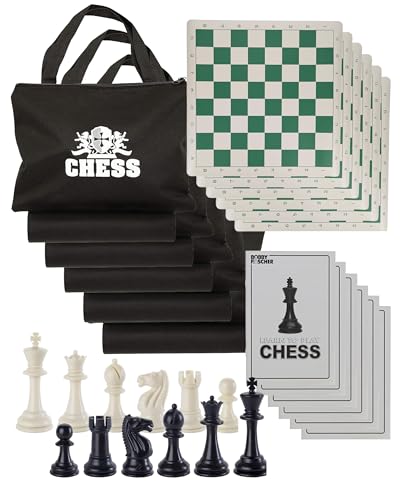
The WE Games Value Tournament set is what I'd buy for a kid who's sticking with it, with a 3.75 inch king, 2.25 inch squares, a 19.75 inch vinyl roll-up board with algebraic notation, 34 pieces including two extra queens, and a bag for the walk to the club.
Set up two kings and a handful of pawns tonight. White pawn on e5, black pawn on d7, then play the same three moves over and over untill the rhythm feels ordinary: d7 to d5, then exd6. Do it ten times and you'll never miss the window in a real game.
Questions people ask me
Can a king or queen capture en passant?
No. Only pawns can do it, because the rule is written into the pawn's movement section rather than the general capture rules. A queen sitting on d5 next to a pawn that just ran from e7 to e5 can capture it normally on e5, and that's the end of her options.
Is en passant ever forced?
Never. You can always decline and play something else. But the right expires the moment you play a different move, so you can't come back to it two turns later.
Why does en passant exist?
It closes a loophole. Once pawns got the option of moving two squares, a pawn could slip past an enemy pawn's guard without ever entering the square that pawn controlled. En passant lets the defender take it anyway, as if it had only moved one square.