Forks: The Chess Tactic That Attacks Two Pieces in One Move (2026)
One move, two targets, and one of them is going to fall. Here's how forks work on every piece, with squares worth memorizing.
The chess tactic that attacks two pieces with one move is a fork, and it wins material because your opponent can only rescue one of them. One attacker, two targets, one move. A knight parked on e5 covers 8 squares at once, and any two of those eight can hold something your opponent needs.
The version that stings includes the king. Land a knight on c7 and it checks the king on e8 while hitting the rook on a8. The check has to be answered. The rook doesn't get answered. That's an absolute fork, and it's how a lot of club games quietly fall apart.
A close cousin deserves a mention: the discovered attack. You step one piece aside and the bishop behind it suddenly hits something. Two pieces attacked by one move, but by two different pieces. Players call that a fork all the time. It isn't, and the difference matters when you're counting.
What counts as a fork, and what doesn't
Three conditions. One piece. Two or more enemy targets. A single move that creates both attacks at the same time.
Geometry sets your ceiling. A knight on a1 attacks 2 squares (b3 and c2). On b2 it attacks 4. On e4 or d5 it attacks 8. Same piece, four times the reach, which is the whole reason you push knights toward the center in the opening.
The payoff is plain bookkeeping. A knight is worth 3 points, a bishop 3, a rook 5, a queen 9, a pawn 1. Fork a rook and a bishop with a knight and you finish 2 points ahead once one of them falls. Fork a queen with a pawn and you're up 8. I keep the full arithmetic on chess piece values because that math shows up in every game you'll ever play.
And yes, a fork is a cheap trick next to a 40-move positional squeeze. I still teach it first. Cheap tricks win club games.
The piece-by-piece fork map
Every piece forks the same way: find two targets sitting on the lines it controls. The knight is the exception, since it ignores lines completely.
| Piece | Forking square (example) | Targets | Typical gain |
|---|---|---|---|
| Knight | c7 | King on e8, rook on a8 | 5 points |
| Pawn | d5 as White | Knight on c6, bishop on e6 | 3 points |
| Bishop | b5 with check | King on e8, knight on c6 | 3 points |
| Rook | e7 | King on e8, knight on c7 | 3 points |
| Queen | d5 | King on g8, rook on a8 | 5 points |
| King | e5 in an endgame | Pawns on d6 and f6 | 2 points |
All of those assume the lines between attacker and target are clear.
The rook row is the one people forget. Rooks don't do anything clever, but a rook on e7 checks the king on e8 and eyes the knight on c7 along the same rank, with nothing in between. If the long-range rules blur for you, what a rook is covers the movement without any fluff.
Knights, bishops and the rest of the family each get a full treatment in my chess pieces breakdown. What matters here is that the fork shape is the same idea for all six: two things, one attacker, no way to save both.
How to see a knight fork coming before it lands
Build one habit. After your opponent moves, look at every knight they own and count the squares it reaches. Say them silently. It takes five seconds and it saves pieces.
The dangerous landing spots are c7, f7, e5, d5, e6 and d6. A knight on c7 can hit the king on e8, the rook on a8 and a bishop on e6 in a single hop. A knight on f7 does the same to h8 and d8. Those squares come up in the first ten moves of a hundred diffrent openings.
The king is what makes the trick work, because a check can't be ignored. The king in chess can't step into an attacked square, can't stay in check, and can't be traded away, so a fork that includes him is forced. That's why the royal fork (king and queen) and the family fork (king, queen, rook) end more beginner games than any other tactic.
Pawn and bishop forks you can set up on purpose
Pawn forks are the ones you can plan three moves ahead, because pawns only move forward. A white pawn stepping to d5 attacks c6 and e6. If black has a knight on c6 and a bishop on e6, a 1-point pawn is attacking 6 points of material. Push with check when the chance appears and the fork becomes impossible to answer in one move.
Bishop forks usually arrive with a check attached. Bishop to b5 covers three squares on that diagonal (c6, d7, e8), and in a hundred Italian and Spanish games that check hits the king on e8 and the knight on c6 at the same time. Black blocks or moves the king, and the knight drops. My bishop chess page goes deeper on the diagonals and why the b5 square keeps showing up.
Loose pieces, and the counting habit that kills most forks
A fork needs targets. Undefended pieces are targets. That's the entire secret, and it's why strong players spend half a second scanning for loose material before every move.
Do this before you commit to anything: name your pieces with zero defenders, then check what enemy knights, bishops and pawns can reach each one. I usually find two loose pieces in my own games, and I've been at this for decades.
Two specific things to watch. A king and queen on the same diagonal is a fork waiting for a bishop or a knight to arrive. A rook sitting on a8 with the king on e8 is the c7 knight's favorite meal. If you're still building the basics, my learn chess walkthrough covers how the pieces move and how to spot a hanging piece before it costs you.
If you need a set to learn on
Fork practice wants a board you can leave set up on a table for a week, not one that goes back in a box every night.

Spin Master Games Cardinal Classics Chess Teacher
- Includes: Chessboard, 32 Chess Pieces, Instructions
The listing says each piece carries its name plus the direction and number of squares it moves, which genuinely helps when the person learning still mixes up a bishop and a rook; the box includes the board, 32 pieces and instructions, ages 8 and up.

Standard flat-bottomed plastic pieces and a folding cardboard board, ages 6 and up, and I'd treat it as the set that lives in a bag rather than the one you keep on the dining table.
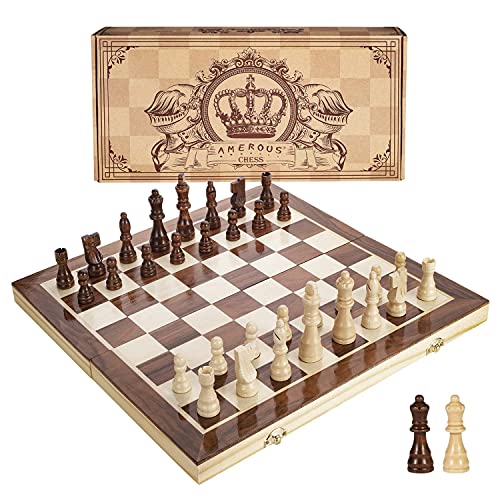
A 15 inch folding wooden board with magnetic pieces, storage slots cut into the board, and 2 extra queens, which is the one I'd take on a train where a knocked board ends the game early. The listing doesn't state a king height, so I can't check it against the usual 3.375 to 4.5 inch range.
One practical next step, and it takes a minute: tonight, after every move your opponent makes, say out loud which squares their knight attacks. Name them. Do that for one full game and c7 and f7 will stop surprising you, because you'll have seen them coming three moves out.
Questions people ask me
What do you call it when one piece attacks two pieces?
A fork. One piece attacks two or more enemy units with a single move, and since your opponent can only move one of them, you usually win material. When the king is one of the targets the fork is absolute, because the check has to be answered first.
Which piece forks the most often?
The knight, by a wide margin. A knight landing on c7 hits a king on e8 and a rook on a8, and a knight on f7 does the same job to h8 and d8. Pawn forks run second, mostly because a pawn is cheap and nobody watches it.
How do I stop missing forks in my own games?
Before every move, list your undefended pieces and check what enemy knights, bishops and pawns can reach. Knights are the ones that surprise people, so count the eight squares a centralized knight covers. It becomes automatic after a few games of doing it out loud.