Which Chess Pieces Can Jump Over Others? Only One, and Here's When It Matters
One jumper out of six piece types, plus the two moves beginners mistake for jumps.
Only one piece in chess can jump over other pieces: the knight. It's 1 of the 6 piece types on the board, and it's the only one allowed to ignore whatever stands between its starting square and its landing square. The queen, both rooks, both bishops, the king, and all 16 pawns get stopped by the first occupied square they meet.
I've watched a club beginner lose a queen to a knight on f5 and then want the move taken back. His pawn on e4 sat right there in the line. Didn't matter. The knight travels two squares one way and one square at a right angle, and whatever sits on those squares counts for nothing. That's the whole rule, one sentence long.
The knight is the only jumper, piece by piece
Here's the full list, and it takes about 30 seconds to learn. The pattern is simple. Every piece that travels in a straight line gets blocked by a body. The knight is the one piece that doesn't travel in a straight line.
| Piece | How it moves | Blocked by a piece in the way? |
|---|---|---|
| King | 1 square, any direction | Yes |
| Queen | Any distance along a rank, file or diagonal | Yes |
| Rook | Any distance along a rank or file | Yes |
| Bishop | Any distance along a diagonal | Yes |
| Knight | 2 squares, then 1 at a right angle | No |
| Pawn | 1 square forward, 2 on its first move; captures diagonally | Yes |
The rook is the cleanest test case. Put a rook on a1 with a pawn on a2 and it has 0 legal moves up the a-file, even though the blocking pawn is a whole square away. The what is a rook piece page spells out that line-of-sight rule, and it's the same idea for the queen and bishop.
You get 4 knights in the opening position, 2 per side, out of 32 pieces total. If you're still fuzzy on the full setup, the how many pieces in chess count is a quick read before you go further. The chess pieces overview covers all six types if you want names and starting squares in one place.
Castling and en passant are not jumps
Two moves look like jumps to a beginner. Neither one is.
Castling is the one people argue about. The king slides 2 squares toward a rook, and the rook lands on the square the king crossed. So the rook has effectively hopped over the king. But nothing jumped over another piece, because castling is illegal if anything at all sits in the gap. One pawn between them kills it, and so does a king that's already moved. My learn chess walkthrough lists the full set of castling conditions, including the rule about not crossing an attacked square.
En passant is the other one. A pawn that has reached its 5th rank can capture an enemy pawn that tries to slip past by moving 2 squares, as if that pawn had only moved 1. It looks like the capturing pawn vaults across a square. It doesn't. The enemy pawn comes off the board, and you only get the option on your very next move. Miss the turn and the right is gone for good.
How many squares a knight has depends on where it stands
A knight changes strength more than any other piece depending on the square it occupies. From a corner it has 2 moves. From the center it has 8. That's four times the reach from the same piece.
| Square the knight stands on | Legal knight moves |
|---|---|
| a1, h1, a8, h8 (corner) | 2 |
| b1, g1, b8, g8 | 3 |
| c1, f1, c8, f8 | 4 |
| a4, h4, a5, h5 (edge) | 4 |
| c3, f3, c6, f6 | 8 |
| d4, e4, d5, e5 (center) | 8 |
One more thing worth knowing: a knight always lands on the opposite color square from the one it started on. Every single move, no exceptions. That's a handy check when a kid insists the knight can reach a square it can't.
Where the jump actually wins games
The knight is worth about 3 points, same as a bishop, and the jump is the reason it stays useful when the board gets cramped. The chess piece values chart puts both minor pieces at 3, which is fair on an open board and undersells the knight in a locked position.
When pawns are jammed together, rooks and bishops stare at a wall. A knight hops the wall. Park one on d5 or e5 with a pawn defending it, and that outpost can be worth more than its 3 points for the next 20 moves.
And here's my concession: on an open board with most pawns traded off, give me the bishop pair every time. A bishop on d4 with clear lines touches 13 squares. Knights don't do that.
Teaching the jump to a beginner in 5 minutes
One drill works better than any worksheet. Set up the starting position, point at the knight on g1, and have a kid count its legal moves out loud: f3, h3, e2. Three moves, and all three require hopping the pawn wall on f2, g2 and h2. That single demonstration usually locks the rule in.
Then move the same knight to c3 and count again. Eight this time. Same piece, diffrent number, and the lesson about central squares lands without a lecture.
If you need a set to learn on
Three options from the listings, and I'd choose differently depending on who's learning. I haven't unboxed any of these myself, so I'm going on the specs and what each set is built to do.

Spin Master Games Cardinal Classics Chess Teacher
- Includes: Chessboard, 32 Chess Pieces, Instructions
The Cardinal Classics Chess Teacher prints each piece's name, direction and number of squares right on the piece, which is the fastest route through the first few games for an 8-year-old (32 pieces, ages 8 and up per the listing).

This is the plain route: standard flat-bottomed plastic pieces on a folding cardboard board, ages 6 and up, and I'd skip it if you already own any basic set.
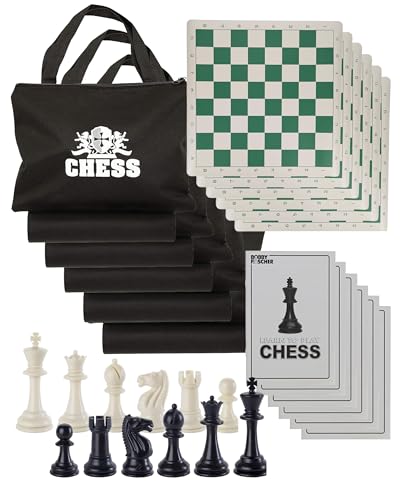
The WE Games set gives you 34 pieces with 2 extra queens, a 3.75 inch king and a 19.75 inch roll-up vinyl board with 2.25 inch squares, which sits inside the US Chess range for king height and square size and packs into a bag.
Your next step: set up the starting position, count the knight's 3 legal moves from g1, then slide it to c3 and count 8. Two minutes at the board and the jump rule is yours for good.
Questions people ask me
Which chess pieces can jump over others?
Only the knight. It moves two squares in one direction and one square at a right angle, and anything sitting on the squares it passes over has no effect on the move. Every other piece is blocked by the first occupied square in its line.
Can a knight jump over pieces and still capture?
Yes. A knight captures whatever sits on its landing square, and the pieces it hops over are irrelevant, friendly or enemy. It can't land on a square held by its own piece, same as any other piece on the board.
Can the king jump over a piece when castling?
No. Castling is illegal if any piece stands between the king and the rook, and the king can't cross a square attacked by the opponent. The rook does finish up on the far side of the king, which is where the jump idea comes from.