Which Chess Pieces Can Move Backwards: Five That Can, One That Can't
Every piece on the board can retreat except the pawn. Here's what backward movement looks like for each one.
Five of the six piece types can move backwards. Pawns are the only ones that can't, and that single exception causes more rules questions at club nights than castling does. Of the 32 pieces in a standard box, the 16 pawns are the only ones locked to forward motion. King, queen, rook, bishop and knight all retreat as happily as they advance, and not one of them needs a special rule to do it.
Every piece and its backward move
The geometry here is dull once you see it. A backward move isn't a separate privilege; it's the same movement pattern pointed toward your own side of the board.
| Piece | Moves backward? | What a backward move looks like |
|---|---|---|
| King | Yes | One square in any direction, straight back included |
| Queen | Yes | Any number of empty squares along a rank, file or diagonal behind her |
| Rook | Yes | Any distance along its file or rank, in either direction |
| Bishop | Yes | Diagonally backward, staying on its own color |
| Knight | Yes | The same two-plus-one L, in any of eight directions |
| Pawn | No | No backward move, no backward capture, no exceptions |
On paper, that's the whole answer. There's no forward-only clause in the laws for the five moving pieces, and a rook on a1 is just as able to take on a8 as a rook on a8 is to take on a1. The chess pieces overview walks the same patterns in the other direction if you want a second pass at it.
Why the pawn is the one piece facing forward
A pawn on e4 can capture on d5 or f5 and nowhere else. Eight pawns per side, all starting on the second and seventh ranks, and every one of them points at the far side of the board. None of the pawn's moves (the single step, the double step, the diagonal capture, en passant) goes toward its own back rank. En passant is still a forward capture: the capturing pawn finishes one square ahead of where it began.
That one-way traffic is why pawn structure matters and piece placement doesn't work the same way. It's also why chess players talk about a "backward pawn," meaning a pawn left behind its neighbors on an open file. It can never walk back to patch the hole. If you want the piece counts per side laid out plainly, the how many pieces in chess breakdown has them.
Backward moves that win real games
The bishop retreat is the quietest good move in the opening. A bishop on g5 that steps back to f4 covers e3, d2 and c1 without abandoning the kingside, and it's a legal move for the same reason a bishop on f4 can go forward to g5. Nothing is used up. The bishop chess piece guide covers those diagonals square by square.
Rooks are the easiest to forget. A rook on e5 that slides back to e1 to hold the back rank is doing real work, and the rook can reverse that trip later in the game as long as the file stays clear. That two-way traffic along a file is the whole point of the piece. The what is a rook page lays out the file and rank business in more detail than I can fit here.
The king moves a single square at a time, and backward is one of the eight options. A king on g1 with a rook already on f1 has exactly one square back, h1, and stepping there is often the only legal reply to a check. Castling is the one king move that isn't a plain step, and it's a two-square trip toward the corner, never away from it. More on that in the king in chess guide.
What beginners get wrong about retreating
Backward is legal. Backward is also not free. Every retreat spends a move, and a knight shuffling between e4 and d2 and back to e4 has burned two tempi for nothing. I spent a full season as a junior pulling my bishop back at the first sign of contact, and my results got worse, not better. Retreating when the position calls for pushing is a real habit to break, and I had it bad.
The other mistake is thinking a piece can't capture going backward. Any of the five can capture in any direction it moves. A rook on a1 that grabs something on a6 can come straight back down to a2 on the very next move. Direction of travel has no bearing on whether a capture is legal.
A ten minute drill that makes it stick
Set a lone knight on e4 on an empty board. It has eight legal destinations, and exactly two of them, d2 and f2, are backward moves. Say them out loud, move the knight there, then say the other six.
Then swap in a bishop on d4, which has 13 moves on an empty board, and name which of them head back toward your side. Ten minutes with two pieces and you'll stop hesitating over this rule for good. A cheap plastic school set with a 3.75 inch king does the job fine, and most of those land in the $15 to $30 range.
If you need a set to learn on
Beginners need a board they can leave out and pick up again, not a collector's set in a box under the bed.

Spin Master Games Cardinal Classics Chess Teacher
- Includes: Chessboard, 32 Chess Pieces, Instructions
The Cardinal Classics Chess Teacher prints the piece name, the direction and the number of spaces on all 32 pieces, which is the reminder a kid actualy needs at move 20, and the listing puts it at ages 8 and up.

The HI-Q Classic set from Point Games is the plain alternative, flat-bottomed plastic pieces and a folding cardboard board, and the listing names ages 6 and up.
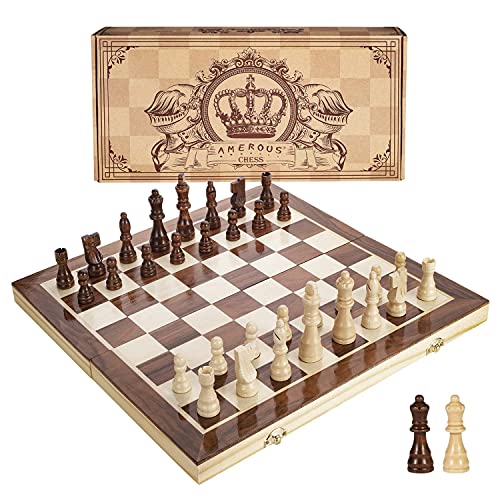
The AMEROUS wooden set is 15 inches, folds in half, holds the pieces in slots and ships with two extra queens, and the magnetic pieces are why I'd throw it in a bag rather than leave it on a shelf.
Put a knight on e4 tonight, list its eight squares out loud, and mark the two that point back toward you. One minute of that beats an hour of reading about it.
Questions people ask me
Can any chess piece move backwards?
Five of the six can: king, queen, rook, bishop and knight. Pawns are the only piece with no backward move and no backward capture. A backward move is just the same movement pattern aimed at your own side of the board.
Can a pawn move backwards to capture?
No. A pawn on e4 captures only on d5 or f5, and it can never take something behind it. En passant looks unusual, but it's still a forward capture, and the capturing pawn lands one square ahead of where it stood.
Do knights move backwards?
Yes. A knight's L works in all eight directions, so rearward moves are just as legal as forward ones. A knight on e4 can go back to d2 or f2 among its eight destinations, and beginners miss those two squares all the time.